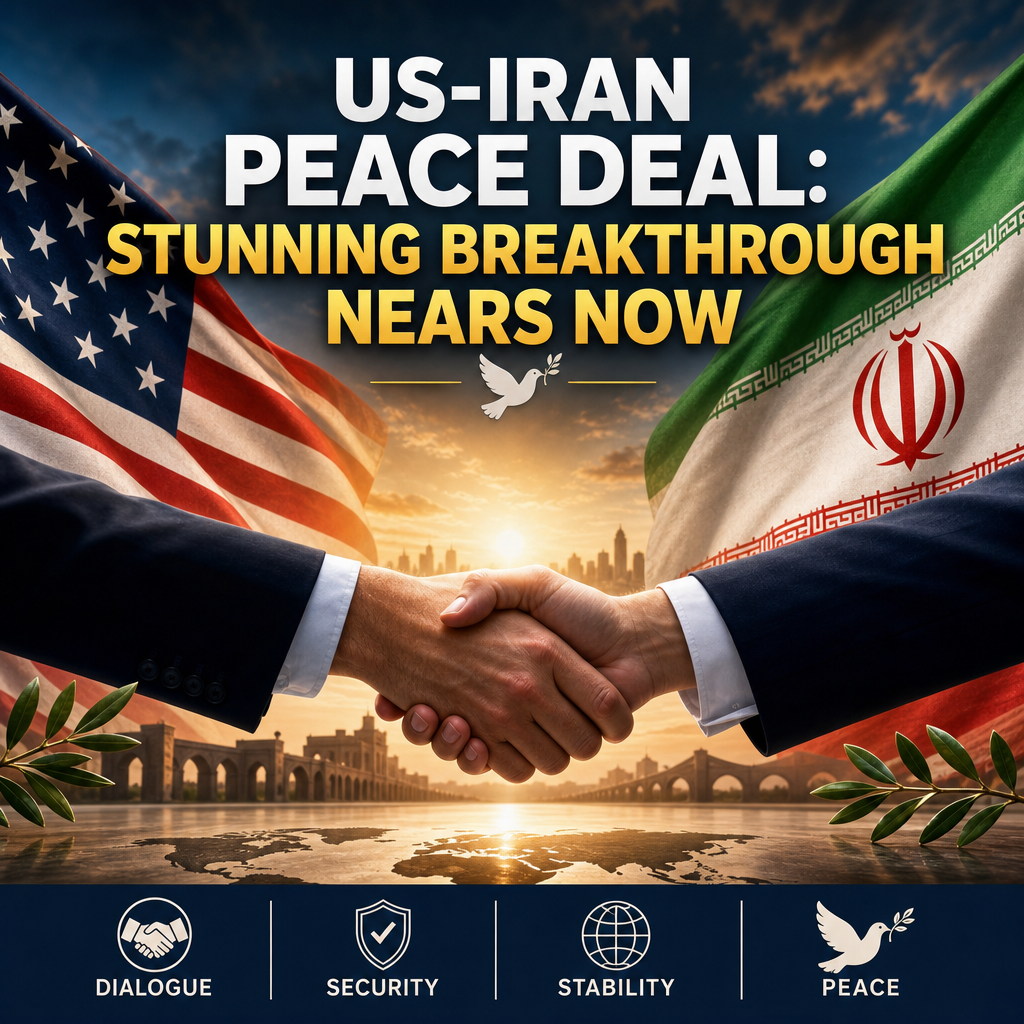
US-Iran Peace Deal: Stunning Breakthrough Nears Now


US-Iran peace deal talk has surged again, but the reality on the ground is more cautious than the headline suggests. Reports circulating through international news wires point to a possible ceasefire framework or wider diplomatic understanding connected to Iran’s regional conflict posture, with Pakistan said to be helping broker language that could hold the line. Still, the emerging picture is not one of a finished settlement. It is a delicate, shifting negotiation shaped by military pressure, regional mediation, and deep mistrust between Washington and Tehran.
What makes this moment notable is not that peace is guaranteed, but that multiple outlets are converging on one basic idea: the parties are no longer speaking only in threats. That alone is significant. Yet the differences in tone across reporting also matter. Some coverage frames the development as a real diplomatic opening, while other reporting treats it as a tactical pause at best and a fragile political maneuver at worst.



US-Iran peace deal: why the latest reports matter
At the center of the current coverage is the claim that an agreed text or near-final framework has been reached for a ceasefire arrangement tied to the Iran conflict. That does not automatically equal a broader peace deal, but it does indicate movement toward terms that both sides, or at least their intermediaries, may be able to live with for the moment.
Al Jazeera’s reporting has tended to emphasize mediation, regional dynamics, and the practical need to stop escalation before it widens. In that reading, the key issue is not whether Washington and Tehran have solved decades of hostility, but whether they can agree on enough to prevent further strikes, retaliation, and spillover across the Middle East. The tone is pragmatic: ceasefire language can be a first rung on the ladder, not the final step.




That is important because diplomacy in this part of the world rarely arrives as a single dramatic breakthrough. More often, it comes in fragments:
– a ceasefire clause here,
– a prisoner exchange there,
– indirect talks through a third country,
– and a period of quiet that may or may not last.
If the reports are accurate, Pakistan’s role as a mediator is also notable. It suggests the negotiations are not just bilateral but regionally buffered, with outside actors trying to reduce the risk of miscalculation. That makes sense in a crisis where even a limited strike or one mistaken response can trigger a much larger confrontation.
Different news outlets, different readings
The main contrast across the news ecosystem is not over whether something is happening, but over what it means.
Sky News-style coverage of this kind of development often highlights the geopolitical stakes and the uncertainty around implementation. That approach tends to ask the practical question: even if an agreement is close, who enforces it, and what happens if one side says the other broke the terms? This is where optimism quickly meets reality. In a region shaped by proxies, airstrikes, sanctions, and long-standing hostility, any ceasefire can be as vulnerable to interpretation as to violation.
RT’s editorial posture, by contrast, often leans toward skepticism of US intentions and Western diplomacy more broadly. From that perspective, any breakthrough is likely to be framed less as a sincere peace effort and more as a response to pressure, military limits, or strategic embarrassment. Whether or not one agrees with that framing, it is useful because it reminds readers that peace language can be used for many purposes. Sometimes it signals goodwill. Sometimes it signals exhaustion. Sometimes it signals an attempt to freeze a bad situation before it becomes worse.
What emerges from those competing lenses is a more cautious conclusion: if a deal is near, it is probably a limited and highly conditional one. It may reduce immediate violence without resolving the core disagreements over nuclear policy, sanctions, regional influence, and security guarantees.
What would a real breakthrough require?
For a US-Iran peace deal to be more than a temporary ceasefire headline, several hard issues would need to be addressed:
– Verification: Any agreement would need monitoring or some mechanism to prove compliance.
– Sanctions relief: Iran would likely want meaningful economic relief, not just promises.
– Security assurances: The US and its partners would want guarantees that further attacks or proxy escalation will stop.
– Regional buy-in: Neighbors and intermediaries would need to support the arrangement rather than undermine it.
– Domestic politics: Leaders in both countries would have to sell the deal to audiences that may distrust compromise.
That last point may be the hardest. In both Washington and Tehran, there are political forces that view compromise as weakness. A ceasefire might be easier to announce than to defend.
A cautious interpretation, not a celebration
It would be tempting to treat the latest headlines as proof that a historic breakthrough is finally at hand. But the more responsible reading is more measured. The evidence suggests momentum, not certainty. It suggests that diplomacy is active, not that peace has been secured. And it suggests that mediators are doing urgent work to contain a volatile situation before it broadens into something worse.
That distinction matters. A ceasefire can save lives even if it is imperfect. A broader peace deal would be a much higher bar, one that requires trust neither side currently enjoys. For now, the best assessment is that the door to de-escalation appears slightly more open than before, but it is still far from unlocked.
If the reported text really is close to final, the next test will be implementation. That is where many such agreements fail: not in the drafting, but in the first hours and days after signing, when each side looks for evidence the other is cheating. The world has seen that story before.
So, yes, the latest developments are worth watching closely. They may mark the beginning of something larger. But until the terms are public, verified, and sustained, the smarter conclusion is not that peace has arrived, but that an opening has appeared—and openings, in this region, can close quickly.